
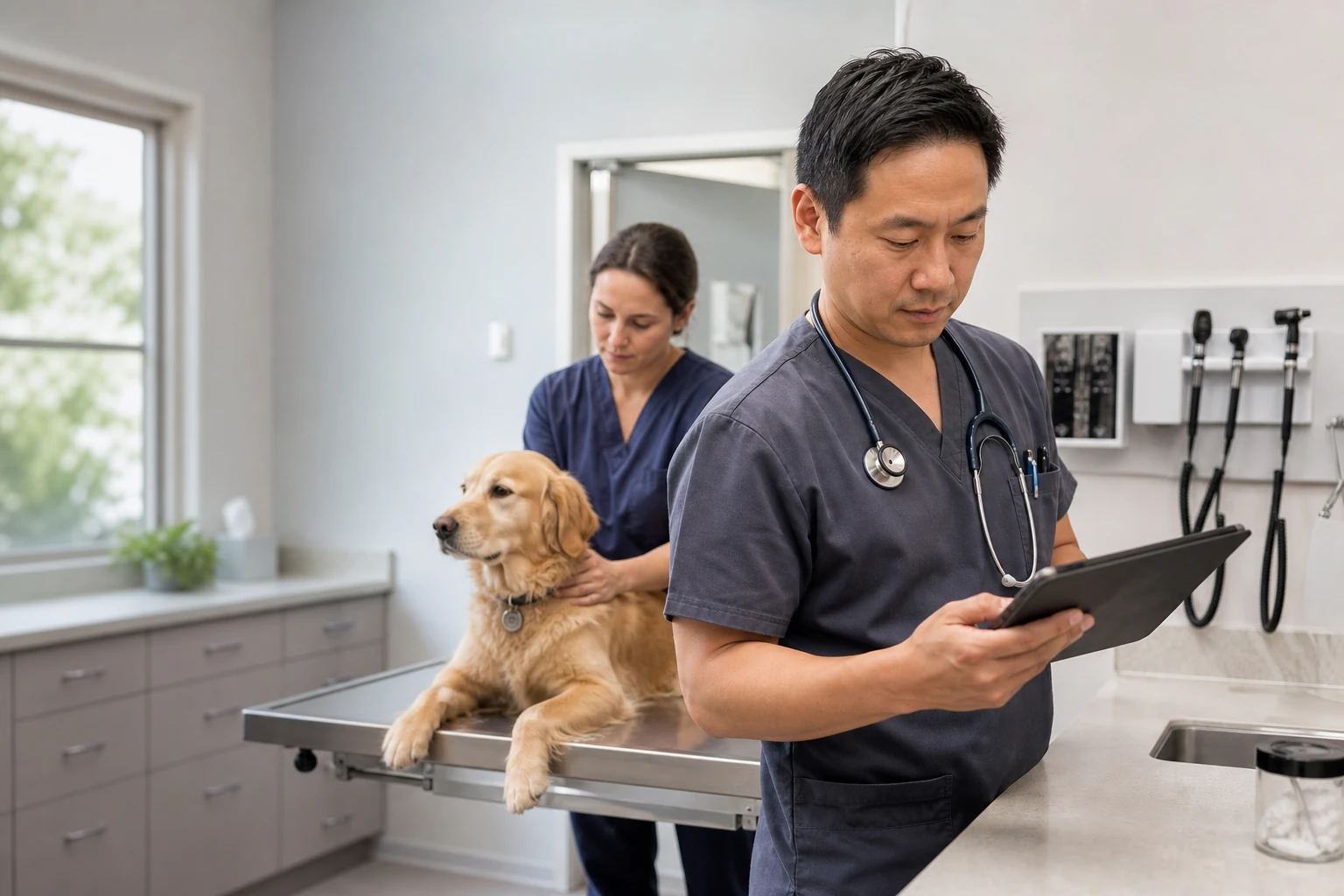
Veterinarians lose 30 to 60 hours a month to documentation.
From exam-room conversation to a SOAP note with ranked differentials. You review, edit, and sign.
DDx+ delivers a SOAP note, ranked differentials with evidence for and against, and diagnostics tied to each differential—so you can review, edit, and sign.
How it works
From exam room conversation to approved record
DDx+ is available today as a veterinary AI scribe and clinic platform. Ambient capture becomes structured SOAP notes and dental charts—with ranked differentials, recommended diagnostics, and clinician review before anything enters your practice software.
Capture
Record exam-room conversation and capture findings during the visit with secure, clinic-scoped tools built for small-animal practice.
- Live and buffered audio capture during exams
- Findings tab for notes and visit files alongside the recording
Generate
After you approve the transcript, DDx+ structures the visit into SOAP notes and dental charts using vocabulary built for veterinary medicine.
- Organized subjective, objective, assessment, and plan sections
- Interactive 3D dental chart generated from the visit conversation
- Species-correct dentition for dogs and cats using modified Triadan numbering
- Per-tooth findings with severity grades and a quadrant-by-quadrant abnormality summary
- Species detected from the patient chart or the conversation, with a prompt when it is unclear
- Every tooth editable before sign-off, then downloadable as a PDF
Assess & recommend
Generated SOAP notes include clinical reasoning—not just transcription. DDx+ surfaces a working diagnosis, ranked differentials, and diagnostics tied to each possibility.
- Differential diagnoses grouped by probability, with must-not-miss flags where appropriate
- Recommended diagnostic mapped to each differential
- Plan diagnostics tracked as Recommended, Completed, or Declined
- Expandable clinical reasoning you can review and edit
Review & export
You remain the author of record. Every note is reviewed, edited, and approved before it is finalized.
- SOAP editing and per-tooth dental chart edits before sign-off
- Copy SOAP notes and operation reports, or download SOAP notes and dental charts as PDFs, today
- Patient import and deeper write-back integrations in active development
Not just a scribe
AI scribes transcribe.DDx+ reasons.
- Differentials grouped by probability, with evidence for and against
- Must-not-miss flags
- Each recommended diagnostic mapped to the differential it addresses
The capacity equation
The workday is full. The record keeps growing.
For a full-time small-animal veterinarian seeing roughly 300 visits a month, documentation can consume the equivalent of dozens of appointments.
30–60
hours per veterinarian per month spent on SOAP documentation
64–112
appointment slots represented by that charting time
20–35%
of clinical working hours absorbed by medical record work
The company we are building
Technology for a profession under pressure
Protect thoughtful work
Strengthen the practice
The goal is not to make veterinarians move faster. It is to remove work that does not require a veterinarian, so more of their limited time can go to patients, clients, and clinical judgment.
Why this matters
Capacity, wellbeing, and clinical quality are connected.
Burnout costs the U.S. veterinary industry an estimated $2 billion annually. Under time pressure, missed diagnostic steps and follow-up carry costs for practices and patients that cannot be measured in hours alone.
“Having tools built specifically for how we practice changes the entire rhythm of the day.”
Partner with Neciva
Whether you run a clinic, invest in veterinary technology, or want to partner with us, we would like to hear from you.
Sources(7 sources)
- American Veterinary Medical Association, “Benchmarking data plus elevating efficiency equals practice productivity,” October 15, 2025.
- Industry estimates of veterinary SOAP / medical-record time burden (2024–2026), converging on roughly 20–56 hours per veterinarian per month and about 20–35% of clinical working hours.
- Derived from AVMA’s 30-minutes-per-patient benchmark applied to a central industry documentation estimate of 32 to 56 hours per veterinarian per month.Equals 64 to 112 appointment-slot equivalents per month; full recovery of those slots is unrealistic.
- Neill, Hansen & Salois (2022), “The Economic Cost of Burnout in Veterinary Medicine.”
- Steffey et al. (2023), “Veterinarian burnout demographics and organizational impacts: a narrative review.”
- Montag et al. (2026), “Understanding error culture in veterinary medicine: a survey among veterinarians across German-speaking countries.”
- Babcock (2024), “How do veterinarians mitigate liability concerns with workforce shortages?” JAVMA.
